Selective narration and information concealment
The Murder of Roger AckroydSelective narration and withholding of information shape Dr. James Sheppard’s manuscript from its first pages to its final confession. What begins as a comic portrait of a doctor keeping village gossip from his sister becomes the method by which a murderer controls the reader’s access to the case: Sheppard reports facts, withholds their significance, and makes an exact account seem complete while leaving its decisive interval unspoken.
Discretion as a Public Persona
Sheppard introduces withholding as a professional and domestic habit. He says that, as a doctor, he aims at discretion, and that he has therefore trained himself to tell Caroline as little as possible about Mrs. Ferrars’s death. He knows that anything disclosed to his sister would spread throughout King’s Abbot within an hour and a half. Caroline nevertheless tends to discover what he conceals, leaving him, as he puts it, the moral satisfaction of not being responsible for the spread of information. This wry account establishes a pattern: Sheppard presents himself as prudent, while making information control part of his ordinary character.
The village setting makes that pattern socially legible. King’s Abbot has two rival general stores, a large railway station, a small post office, and a population whose recreations can be summed up as gossip. Caroline’s intelligence network is comic but effective: she learns that Ralph Paton is staying at the Three Boars, despite Sheppard having heard from Roger Ackroyd that Ralph was in London. Surprised, Sheppard breaks his own rule and lets that information slip. The scene shows both the circulation of news and the narrator’s capacity to regulate it; his discretion is not an absence of knowledge but a choice about when to disclose it.
That contrast also frames the arrival of the foreigner at the Larches. Caroline’s usual sources cannot tell her who he is or where he came from, and the one fact available to the village is his interest in growing vegetable marrows. Sheppard relishes the failure of her intelligence network even as he observes its reach. The episode introduces a world in which information is constantly sought, traded, and interpreted, making the narrator’s selective control of it a central feature rather than a private quirk.
Omission in the Case Narrative
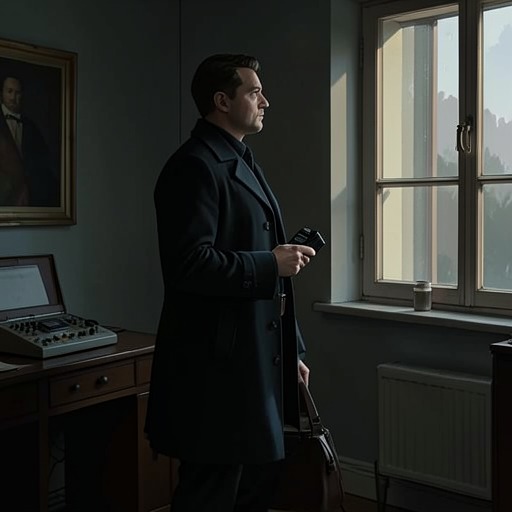
Sheppard’s most consequential early omission is embedded in a passage that insists on precision. Roger’s letter was brought in at twenty minutes to nine; Sheppard left him just before ten minutes to nine, with the letter still unread. He describes pausing at the door, looking back, and wondering whether he had left anything undone, then shaking his head and going out. The minute marks and small gestures make the account sound scrupulous. Yet in his later manuscript he identifies that interval as the place where the narration conceals what happened: he had inserted no visible break after the first sentence, so that a reader might not wonder what occurred during the blank ten minutes. The sequence is a model of selective narration: the statements are true, but their arrangement suppresses the act that would change their meaning.
The same strategy operates through Sheppard’s performance of cooperation. When Inspector Davis mentions blackmail, Sheppard first responds as though startled, then says he has nearly decided to make a clean breast of things and narrates the evening’s events. His apparent candor gives the police a motive for the murder: Mrs. Ferrars’s missing letter. But the declaration that he is telling everything is itself part of a managed account. Sheppard supplies a version of events that is extensive enough to appear complete while the most important action remains hidden within the interval he has not narrated.
His account of visiting the Three Boars is similarly guarded. When Poirot asks why he went there on the night of the murder, Sheppard says that someone had to inform Ralph of his uncle’s death and that he thought no one else knew Ralph was in the village. Poirot presses the possibility that Sheppard wanted to reassure himself that Ralph had been at home all evening; Sheppard sharply denies it. The exchange makes the difference between a stated reason and an unstated stake visible. His narration preserves the explanation he offers while refusing the implication Poirot draws from it.
A First-Person Witness with Divided Knowledge
Sheppard explicitly describes a change in the relationship between his narrative and Poirot’s investigation. From Roger’s death on Friday evening until Monday night, he says, the account could have been Poirot’s: he was beside the detective, saw what Poirot saw, and tried to read his mind. But he admits that he failed. Poirot showed him discoveries, including the gold wedding ring, while withholding the impressions that gave those discoveries their meaning. After Monday, Poirot worked on his own, and Sheppard learned about his activities through the village rather than through the detective’s confidence. Sheppard’s retrospective division of the narrative therefore marks two forms of incomplete knowledge: Poirot conceals his deductions from his companion, while the companion conceals his own crime from both Poirot and the reader.
This account of divided knowledge supports the manuscript’s air of collaborative detection. Sheppard likens the investigation to a jigsaw puzzle to which everyone contributes a small piece, reserving for Poirot the credit for fitting the pieces together. Yet the metaphor also exposes the narrator’s position: Sheppard can present himself as a witness who possesses only a fragment, even though he knows more than he discloses. His account of the investigation is not merely limited by what he sees; it is designed around what he chooses to leave out.
The village’s gossip network repeatedly threatens to undo such control. Colonel Carter tells Sheppard that he has heard blackmail mentioned and speculates that a woman must be involved. Sheppard’s narration records the circulation of the rumor but does not thereby reveal his own connection to it. Elsewhere, Poirot turns the same local network into an investigative tool: to locate Ralph, he invents a nephew with mental trouble, asks Caroline for nearby nursing-home names, and learns that Sheppard brought a patient to one of them early on Saturday morning. Information that Caroline gathers or Poirot elicits can uncover what Sheppard has tried to keep private. The contrast is sharp: the narrator treats disclosure as something he can manage, but other people’s questions and connections make his concealments discoverable.
The Manuscript Reinterpreted
The ending changes the status of the whole account. At five in the morning, exhausted and with his arm aching from writing, Sheppard says that he has finished his task. He had intended the manuscript to be published as the history of one of Poirot’s failures. That projected title would have turned the record of the investigation into one last deception: the reader has been following not a neutral case history but a murderer’s carefully shaped defense of his own apparent innocence.
Sheppard’s final explanation also revises the sequence of his intentions. He says that he may have meant to murder Roger all along, and that on hearing of Mrs. Ferrars’s death he became convinced she might have told Roger everything. Roger’s agitation could mean that he knew the truth but was giving Sheppard a chance to refute it. Sheppard therefore went home and took precautions, while allowing himself the possibility that Roger’s trouble might concern Ralph instead. He had the Dictaphone Roger had given him to adjust two days earlier, persuaded Roger to let him work on it rather than return it to the company, and took it to Fernly Park in his bag. These details reveal how the narrator’s apparent access to ordinary events—an errand, a conversation, an object in his possession—can conceal preparation for a crime.
His explicit discussion of the ten-minute interval is the clearest statement of his method. He praises the neatness of the passage because every sentence is true, then points to the possibility of putting a row of stars after the first sentence. The missing passage, not a false sentence, is what protects him. The reader is forced to reread the manuscript as a structure of carefully chosen facts and gaps, in which exactness can serve concealment as readily as truth.
Narrative Function and Significance
Selective narration works at several levels at once. Sheppard’s comic observations about Caroline establish him as a familiar, discreet village doctor; his reports of conversations and movements make him seem a reliable guide through the inquiry; and his final confession reveals that the same voice has been using those qualities to manage suspicion. The narrative’s most effective misdirection is not a succession of fabricated statements but a discrepancy between what is said and what the reader is allowed to infer.
The device also turns the village’s appetite for information into an ironic counterforce. Caroline’s inquiries, the spread of rumor, and Poirot’s deliberate questioning all make concealed facts circulate through other routes. Sheppard repeatedly portrays himself as withholding information to preserve discretion or to avoid encouraging Caroline’s guesses. In the end, the distinction between responsible discretion and criminal concealment collapses: the habit that initially sounds socially prudent is exposed as the outward form of his control over a narrative meant to hide murder. The confession does not merely supply the solution; it reveals that the manuscript’s apparent completeness was itself part of the deception.